
The spotted hyena has one of the most physically demanding births of any land mammal. Understanding why gives safari travellers a much deeper view of one of Africa's most misjudged predators.
The cause is a single piece of anatomy: females deliver cubs through an elongated, penis-like clitoris called a pseudopenis, the same structure they use to urinate and mate. Nothing else in the animal kingdom quite matches it.
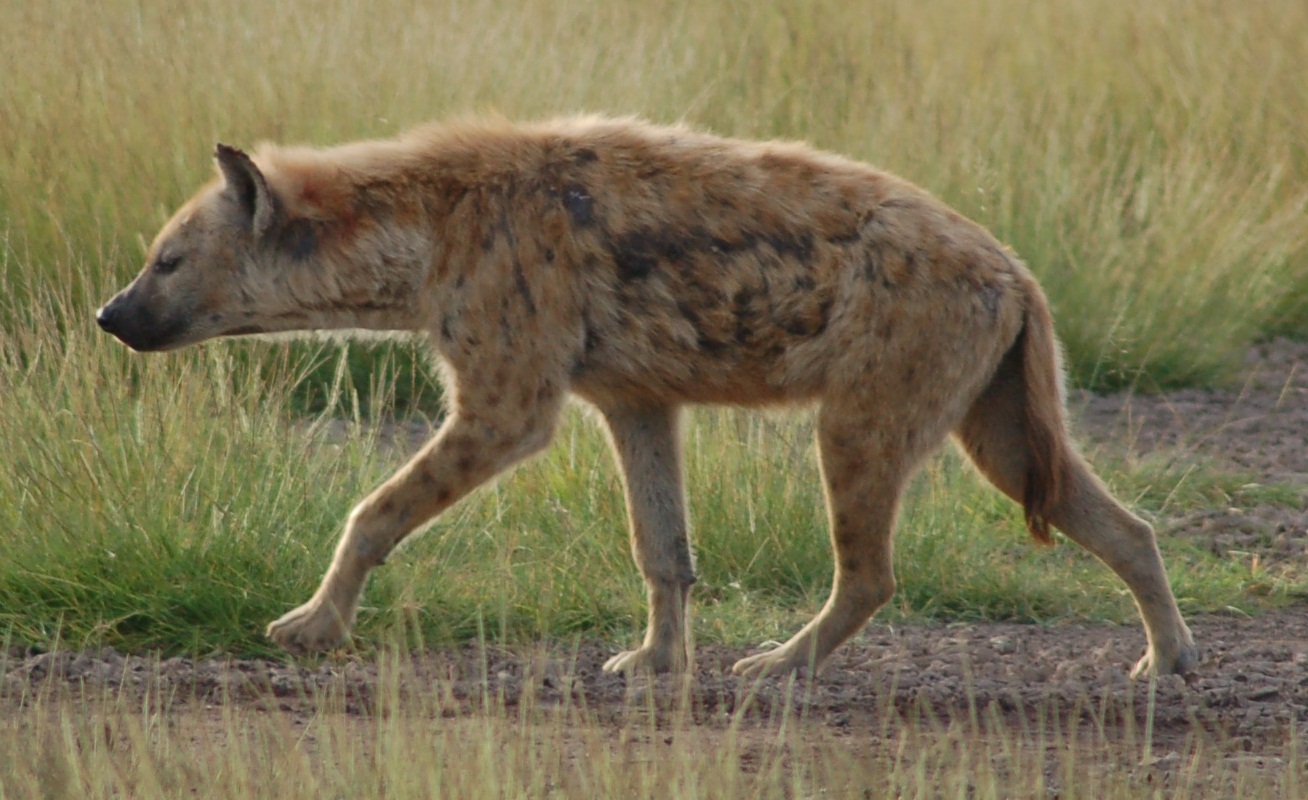
Which Hyena Are We Talking About?
Africa is home to four hyena species, but only one of them gives birth this way. The spotted hyena, Crocuta crocuta, is the species behind the pseudopenis. Striped hyenas and brown hyenas have a far more typical female anatomy, and the aardwolf, a smaller insect-eating relative, is not affected by this trait at all.
When people describe the painful hyena birth process, they are describing the spotted hyena specifically, the same species travellers encounter on safari across the Maasai Mara, the Serengeti, and much of southern and eastern Africa.
Why There Is No Normal Birth Canal
Spotted hyenas are the only placental mammal without an external vaginal opening. High androgen exposure in the womb masculinises the female's genitalia, producing a pseudopenis nearly identical in size and shape to the male's, complete with the ability to become erect.
Every cub passes through this single channel, which measures roughly 2 centimetres across at the opening while a cub's head and shoulders measure closer to 6 or 7 centimetres. Researchers Laurence Frank and Stephen Glickman, whose long-running studies on hyena reproduction remain foundational, documented that the tip of the pseudopenis ruptures during a female's first delivery because the tissue has never stretched.
What Happens During Delivery
On a female's first birth, the tip of the pseudopenis must rupture to let the cub through. Labour can run as long as 48 hours. Because the tissue does not stretch, the cub is often compressed and slowed inside the canal, cutting off oxygen. Research on wild and captive hyenas puts first-litter cub mortality at up to 60 per cent, mostly from suffocation during a prolonged delivery. A short umbilical cord increases the risk because the placenta can detach before the cub has fully emerged.
The mother faces her own risk. Studies of wild hyena populations record death rates of 9 to 18 per cent among first-time mothers, usually from blood loss or infection following the tear. Later births are less dangerous because the scarred tissue stays more open and the canal no longer has to tear from scratch.
Spotted hyena litters typically contain one or two cubs, occasionally three. Cubs that survive arrive unusually developed for newborn carnivores: their eyes are open, their teeth have erupted, and littermates may fight within hours to establish rank. When fatal, this behaviour is known as siblicide and is thought to establish priority access to milk.
Mating Is Just as Unusual
The same anatomy that complicates birth changes mating entirely. Because the female's opening sits at the tip of the pseudopenis rather than in a conventional location, males cannot force copulation. The female has to relax and retract the tissue to allow mating to happen, meaning reproductive control rests almost entirely with her.
Many researchers connect this to the evolutionary story behind hyena birth: female hyenas rank above males in every clan, and the biology behind that dominance appears to carry a cost at nearly every stage of reproduction.
Life in the Den
After birth, mothers keep newborn cubs in a private den for the first few weeks, often choosing a narrow entrance that keeps out larger predators and limits contact with other clan members. Some low-ranking females favour this strategy to protect a first litter until the cubs are strong enough to move to the communal den, where multiple mothers raise cubs from different litters side by side.
Cubs nurse for an unusually long period among carnivores, typically 12 to 18 months, although they begin tasting meat from kills near the den at around 3 to 5 months old. This long nursing period is part of why female hyenas invest so heavily in surviving that first, most dangerous birth.
Why Hyenas Evolved This Way
The leading explanation ties the pseudopenis to hyena social structure. Female hyenas outrank males in the clan hierarchy, and researchers believe the same hormonal exposure that builds their size and aggression also shapes this anatomy. One effect is that females control mating entirely, since forced copulation is physically impossible through a pseudopenis.
Scientists still debate whether the anatomy is a direct evolutionary target or a side effect of hormones selected for aggression and rank. The organisational hypothesis argues that androgen exposure in the womb builds both the muscular, dominant female hyena and her unusual genitalia as a single package. Under this view, social dominance and difficult reproductive anatomy are linked at the hormonal level.
What This Means on Safari
Hyena den sites are among the more reliable wildlife sightings in Kenya and Tanzania because clans reuse the same den for weeks or months while cubs are too young to travel. A guide who knows an active den can position a vehicle at a respectful distance while still giving travellers a clear view of cubs, nursing females, and interactions around the den mouth.
Den sightings are common in the Maasai Mara conservancies and parts of the Serengeti. Guides who track individual clans over multiple seasons can often identify which female recently gave birth and estimate the age of her cubs. Early morning and late afternoon tend to produce the most activity, while cubs remain closer to the den during the heat of the day.
Understanding what a mother hyena has survived changes how most travellers see her. A scarred or limping female at a den is not simply an odd-looking animal. She may be a survivor of one of the most dangerous births in the animal kingdom, still raising cubs against extraordinary odds.
How This Compares to Other Difficult Births
Difficult births are not unique to hyenas. Giant pandas face high stillbirth rates in captivity, while dolphins and other cetaceans can lose calves during prolonged labour in open water. What sets the spotted hyena apart is that the difficulty is built into the reproductive anatomy of every female, rather than resulting from a particular pregnancy or unusually large offspring.
Lions and leopards give birth through a conventional birth canal, where complications can happen but are not the built-in norm. Hyenas are unusual because the danger sits within the mother's body plan rather than primarily in her environment.
What Researchers Are Still Trying to Answer
Decades after Frank and Glickman's original studies, scientists are still refining how much of the pseudopenis is a direct evolutionary adaptation and how much is a side effect of hormones selected for other traits. Genetic research is examining the androgen receptors and signalling pathways behind the masculinised anatomy.
Field researchers following clans in the Maasai Mara and Serengeti across generations have also tracked how females fare after difficult first births. The data consistently show that survivors of a severe first tear tend to have significantly easier subsequent deliveries.
Frequently Asked Questions
- Why do hyenas give birth through a pseudopenis? Female spotted hyenas have no external vaginal opening. Their genitalia develop into a pseudopenis, and every cub must pass through this structure.
- How dangerous is hyena birth for the mother? Studies record first-time mother mortality of 9 to 18 per cent, mainly from blood loss or infection after tearing during delivery.
- How many hyena cubs die during birth? Research on first litters records cub mortality as high as 60 per cent, mostly from suffocation during prolonged delivery.
- Do later hyena births get easier? Yes. After the first birth, scarred tissue remains more open, reducing the risk to mother and cub during later deliveries.
- Do all hyena species give birth this way? No. Only the spotted hyena has this anatomy. Striped hyenas, brown hyenas, and aardwolves give birth through a conventional canal.
- Why do newborn hyena cubs fight? Littermates may compete for dominance and priority access to milk within hours of birth. In some litters, this aggression becomes fatal.
- Where can travellers see hyena cubs? Active den sites in the Maasai Mara conservancies and parts of the Serengeti offer some of the most consistent sightings.
Insider TipAt a hyena den, remain quiet and let your guide choose the viewing distance. Early morning and late afternoon generally offer the best chance of seeing active cubs without disturbing the clan.
Ready to Make It Real?
Our travel specialists will design a tailor-made itinerary around your exact dates and interests, at no obligation.
Get a Free Quote