Kenya's Maasai Mara recently raised its park fees to $200 per person per day. Tanzania's Serengeti sits at $180. We look at what those fees mean for your safari budget and the value of Tanzania's northern circuit.
The Fee Gap Is Real
Kenya's Maasai Mara National Reserve now charges $200 per person per day for non-resident visitors. Tanzania's Serengeti National Park charges $180 per person per day. On a typical 3-night Serengeti stay, that's a $60 saving per person in entry fees alone, before accommodation, flights or any other costs.
For a couple on a 7-day Tanzania circuit combining Tarangire, the Serengeti and Ngorongoro, park fees alone typically run $300–$500 less than an equivalent Kenya itinerary. That difference pays for an extra night at a quality camp, a sunrise hot air balloon, or a Zanzibar beach extension, and we're increasingly seeing travellers put it toward exactly that.
Three Parks, Three Ecosystems: All in One Trip
Part of what makes Tanzania genuinely better value is the diversity packed into a single itinerary. The classic northern Tanzania circuit moves through three completely different landscapes, and no two days feel the same.
- Tarangire National Park: Tanzania's most underrated park. Vast elephant herds move beneath ancient baobab trees along the Tarangire River. Far fewer vehicles than the Serengeti, exceptional dry-season game viewing, and a photographic backdrop that is genuinely unlike anywhere else in East Africa.
- Serengeti National Park: Africa's most iconic wildlife landscape. Over 30,000 km² of open savannah, 1.5 million wildebeest in migration, and the most densely populated lion country on earth. The Serengeti alone justifies the flight to Tanzania.
- Ngorongoro Crater: This collapsed volcanic caldera forms a natural wildlife enclosure. Its 260 km² floor holds approximately 25,000 large mammals, including some of Africa's last free-roaming black rhino. There is nothing comparable to it anywhere in Kenya.
The Migration: Tanzania Has It for More of the Year
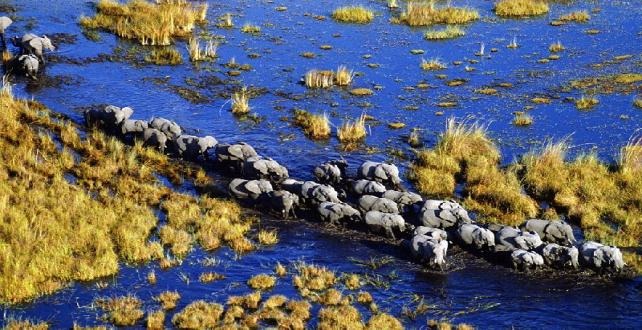
Many travellers believe the Great Wildebeest Migration only happens in Kenya's Maasai Mara. In fact, the migration is a year-round cycle, and the wildebeest spend the majority of the year in Tanzania.
From January through June, the herds are in the Serengeti. February brings the calving season in the southern Ndutu region: one million calves born in three weeks, drawing the greatest concentration of predators of the year. By April the columns begin pushing north through the central Serengeti. By July the first animals cross into Kenya.
Between July and October, the famous Mara River crossings can also be witnessed from Tanzania's northern Serengeti: often with significantly fewer vehicles than the Kenyan side. If a crossing is on your list, you don't necessarily have to pay Mara prices to see it.
Ngorongoro: Kenya Has No Equivalent
The Ngorongoro Crater is Tanzania's ace card. A UNESCO World Heritage Site and one of the Seven Natural Wonders of Africa, the crater floor supports the highest density of wildlife of any area on the continent. Black rhino, lion, leopard, elephant, buffalo and hippo all share the same 260 km²: within the walls of an ancient extinct volcano.
In fifteen years of designing East Africa itineraries, our guides consistently report that, for almost every client, the most memorable game drive happens inside Ngorongoro. It stands out whatever else is on the programme. Nothing in Kenya replicates it.
The Zanzibar Factor
Zanzibar makes a natural beach extension to a Tanzania safari. This UNESCO-listed spice island off Tanzania's Indian Ocean coast offers white sand beaches, turquoise water, the medieval lanes of Stone Town, and some of East Africa's finest diving and snorkelling.
A Tanzania safari combined with 3–4 nights in Zanzibar gives you time in the bush and on the coast. It's a short, inexpensive flight from Arusha or Dar es Salaam. Spend those final days by the sea, with time to rest after the early starts on safari.
When Kenya Still Makes More Sense
We sell both: so we want to be straightforward about this. Kenya remains the right call in several situations.
- Peak Mara river crossings (July–October): The intensity of crossings from a private conservancy camp positioned directly on the Mara River is still unmatched on the Kenyan side for sheer drama and proximity
- Samburu National Reserve: Home to species found nowhere in Tanzania: Grevy's zebra, reticulated giraffe, gerenuk and Somali ostrich. Essential for serious wildlife enthusiasts and photographers
- Lewa Conservancy and Laikipia Plateau: Exclusive, low-density safari experiences with horse riding, night drives and walking that Tanzania's parks don't permit at the same level
- Amboseli National Park: Elephant herds with Kilimanjaro as a backdrop make this one of Africa's most photographed scenes, and it's uniquely Kenyan.
- Logistics: If you're already based in Nairobi, a Kenya safari is simpler and cheaper to piece together on flights alone
Insider TipFor most first-time Africa travellers, particularly those travelling from the US, UK and Australia, we currently see Tanzania as the strongest value in East Africa. The park circuit offers varied wildlife, time in Ngorongoro and the option to finish in Zanzibar. Kenya is a good fit for repeat visitors, Samburu enthusiasts or anyone prioritising the Mara river crossings at peak season. Tell us what interests you and we will help you choose your route.
Ready to Make It Real?
Our travel specialists will design a tailor-made itinerary around your exact dates and interests, at no obligation.
Get a Free Quote